WorkSitePass
by WorkSitePass
Worker certifications, forms and site requirements in one place — so the superintendent at the gate gets the same answer in seconds.
TL;DR
- Founded, researched and designed a certification-readiness product for small and mid-sized general contractors.
- Discovery reframed it from a tracking problem to a visibility problem: built for the superintendent at the gate at 7am, not the safety manager at a desk.
- Live on web and mobile, with contractors running free trials. Nobody has converted to paid yet — and this case study says so.
- Role
- Founder, product designer and researcher
- Timeline
- 2025 – present
- Platform
- Web, iOS, Android
- Tools
- Figma
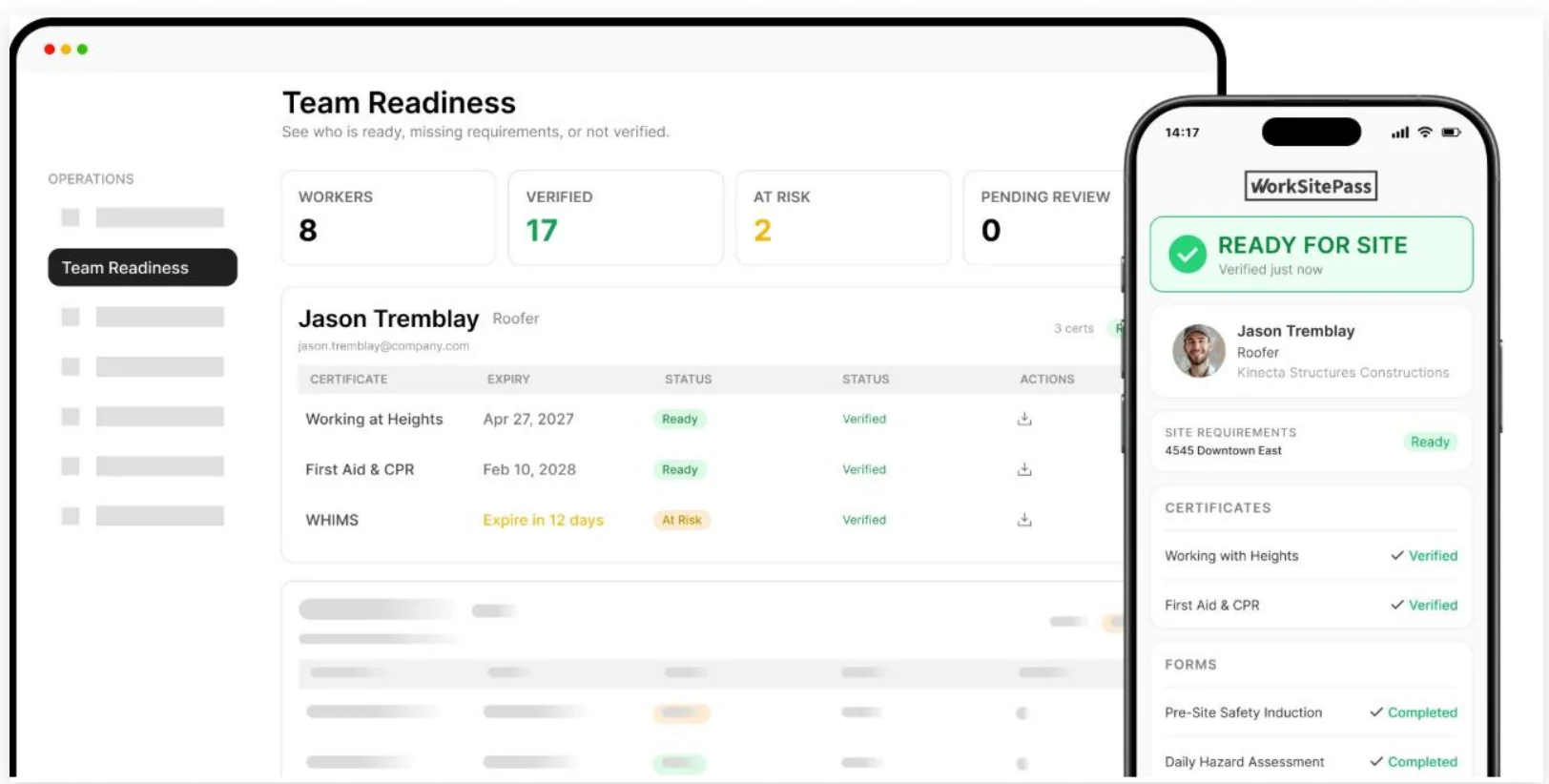
WorkSitePass keeps worker certifications, forms and site requirements in one place for construction teams — so everyone gets the same answer in seconds, with or without a dedicated safety manager.
- Founder, designer and researcher. I do the discovery calls, the product decisions and all of the design. There is no brief to accept or reject — I have to write it.
- 2025 to now. Live on web and mobile, in active discovery with contractors across North America.
- Deliberately narrow. Small and mid-sized general contractors, sub-$8M projects. Not enterprise safety management.
The user problem: one moment, at the gate
The normal world
And
A general contractor pre-screens the sub's paperwork, spot-checks tickets during orientation, and keeps photos or a spreadsheet. It mostly works.
The break
But
It depends on one person staying vigilant. A sub sends whoever's available, a ticket has lapsed, and the super at the gate has no way to know. The office system might know — the gate doesn't.
The resolution
Therefore
Make certifications visible at the moment and place where the question is actually asked, and flag expiries far enough ahead that they never become a gate problem.
The protagonist is the site superintendent at 7am, not the safety manager at a desk. That distinction turned out to be the whole product.
Discovery: what contractors actually told me
Around a dozen conversations with site superintendents, health-and-safety managers and contractors across Canada and the US. Not usability sessions — discovery calls, where the goal was to find out whether the problem I imagined was the problem they had.
How I ran the calls:
- Questions, not a pitch. “When a worker shows up and someone has to confirm their tickets are current — how does that actually happen?”
- Ask about the last failure. “When it slipped last time, did work stop, or did it get caught later? What did it cost?”
- Test whether it's a system. “Is that a system, or one person being vigilant?” — the question that consistently opened people up.
Competitive analysis: where the gap actually was
Salus and SiteDocs are good products. They're built for a health-and-safety manager running a program from a desk — and priced and scoped for companies big enough to have one.
Paper & spreadsheets
- The default today
- Free, instant, universal
- Answers nothing at the gate
- Fails when one person is away
Salus / SiteDocs
- Full H&S program management
- Built for the safety manager at a desk
- Months of setup, training required
- Priced for larger contractors
WorkSitePass
- Certification visibility only
- Built for the super at the gate
- Setup in minutes — a design constraint
- Priced for sub-$8M projects
The gap wasn't a missing feature — it was a missing user. Every tool in this market serves the desk; the decision happens at the gate.
Certifications are money, not paperwork
This is the part outsiders miss, and it's why the problem is worth solving commercially. A lapsed certificate isn't an admin nuisance — it's bid eligibility and cash.
01
Ontario — bid eligibility
IHSA COR certification is required to bid City of Toronto, Metrolinx, Infrastructure Ontario and TTC work. A lapsed certification program locks a contractor out of the largest contracts available to them.
02
Alberta — direct rebate
Maintaining COR earns up to 20% back on WCB premiums. Compliance is a line item on the P&L, not an overhead cost.
03
The immediate cost
When it's caught at the gate, a crew stands still. When it's caught in an audit, it's worse. Both are expensive, and neither shows up in a safety report as a design problem.
04
Expanding across North America
Supporting US certificates alongside Canadian ones — OSHA, CSTS, IHSA, Red Cross — took the product from a provincial tool to one a contractor can use anywhere they work.
Same data. Different people, different moments.
The reframe that shaped the product: this isn't a tracking problem, it's a visibility problem. The same certification data is needed by different people, in different places, at different moments — and the existing tools only serve one of them.
Site superintendent
At the gate, 7am
Green or red on every worker arriving, in seconds, on a phone, outdoors.
H&S manager
At a desk
The program view — what's expiring, which subs are compliant, audit-ready records.
GC owner
Before a bid
A liability snapshot, and confidence the COR program won't cost a contract.
Field worker
On their phone
Upload once, see what each site requires, know they're cleared before travelling.
Competitors serve the H&S manager well. Nobody was serving the superintendent.
From what I heard to what I built
Four decisions that exist only because of a discovery conversation. None of them were in my first version of the idea.
- “The office system knows. The gate doesn't.”Mobile-first for the super, not a mobile companion to a desktop admin tool
- “It's one person being vigilant.”Expiry alerts on a 30-day horizon, so renewal never becomes a gate decision
- “Our subs won't all use another platform.”The GC gets visibility without requiring every sub to be on it
- “What killed our last rollout was setup.”Setup in minutes treated as a hard design constraint, not a marketing claim
The third row is the one I'd have got wrong on my own — I assumed adoption would be all-or-nothing across every subcontractor.
The readiness flow, end to end
One worker, one path. Everything in the product exists to make step four take under ten seconds, outdoors, on a phone.
- Worker uploads — certificates added once, from the worker's own phone.
- Verified at source — credentials checked against the issuing body, not a photo taken on trust.
- Assigned to a site — the site defines its requirements; the worker is matched against them.
- Cleared at the gate — green or red, in seconds, before anyone walks on.
- Expiry flagged ahead — renewals surfaced 30 days out, so they never become a gate problem.
How it changed: from a wallet to site readiness
It started as a certificate wallet — an app where a worker keeps their tickets. It became site access readiness, ending in check-in at the gate. That shift came from the conversations, and it changed what the product is for.
A certificate wallet
First
A worker keeps their tickets on their phone. Useful, but it answers the worker's question, not the site's.
Requirements per site
Then
Every site defines what it needs. Now a certificate can be measured against something.
Site access readiness
Now
Ready or not ready, per worker, per site — ending in check-in at the gate.
There is no “worker profile” page in WorkSitePass, and that's deliberate. The worker owns their identity, the phone is the primary record, and the dashboard is an operational view of that identity — not a CRM of people.
A company never asks “who is this person?” It asks: is this worker ready · which site are they on · what's missing · when does it expire.
Built for outdoors, in a hurry
- Status you can read at arm's length. Green or red as the primary signal, always paired with a label — bright sun, gloves, a phone held at an angle.
- One screen answers the gate question. No navigation to the answer. The readiness state is the landing state.
- Same system, three surfaces. Admin console, superintendent mobile view and worker wallet share one component set, so the data reads identically in all three.
- Setup that a superintendent can do. Every configuration screen is designed on the assumption that nobody will read documentation.
The pass itself
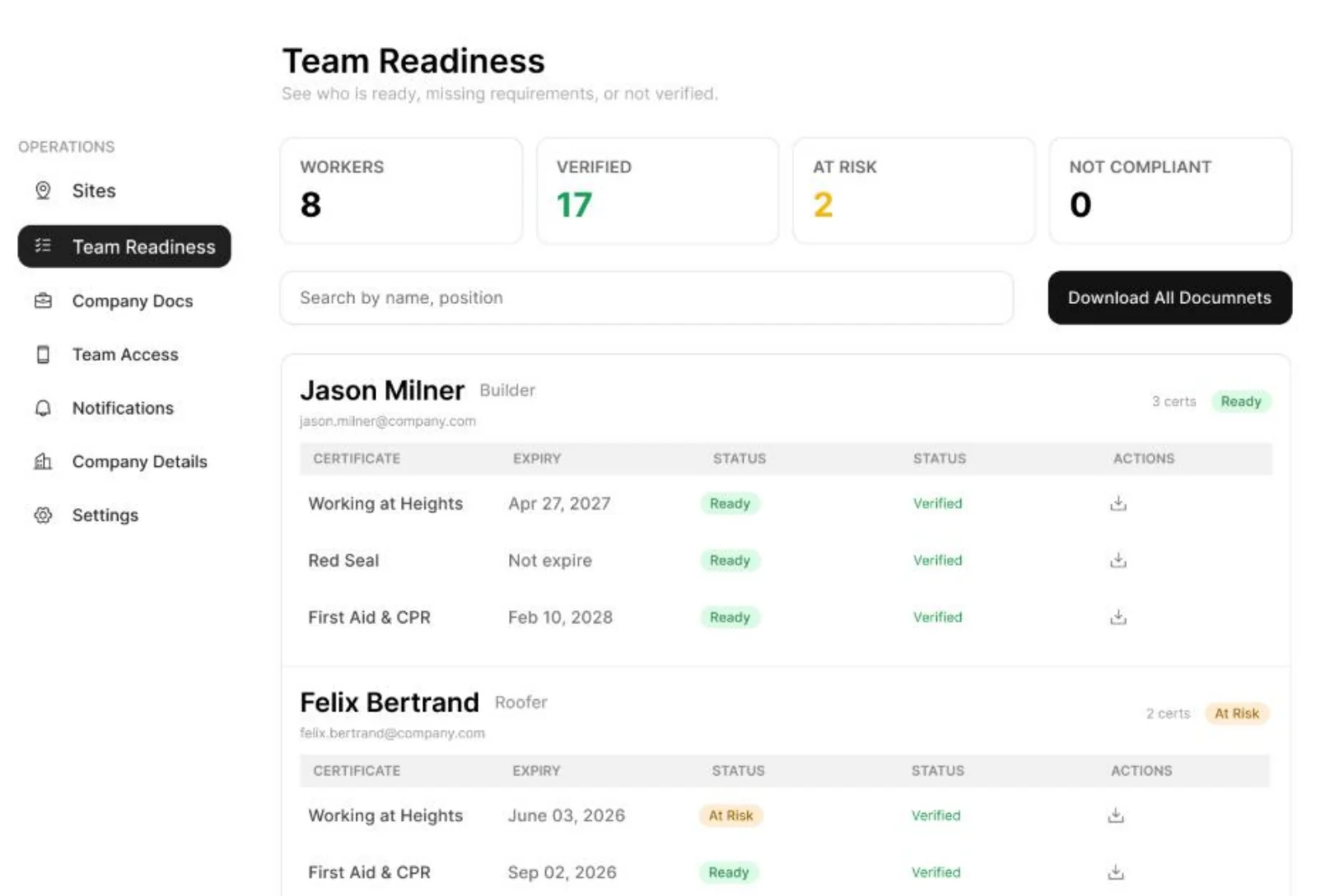
The worker's wallet and the superintendent's check are two sides of one object. The worker uploads once and carries it between general contractors; the super scans and gets an answer without needing the worker's paperwork at all.
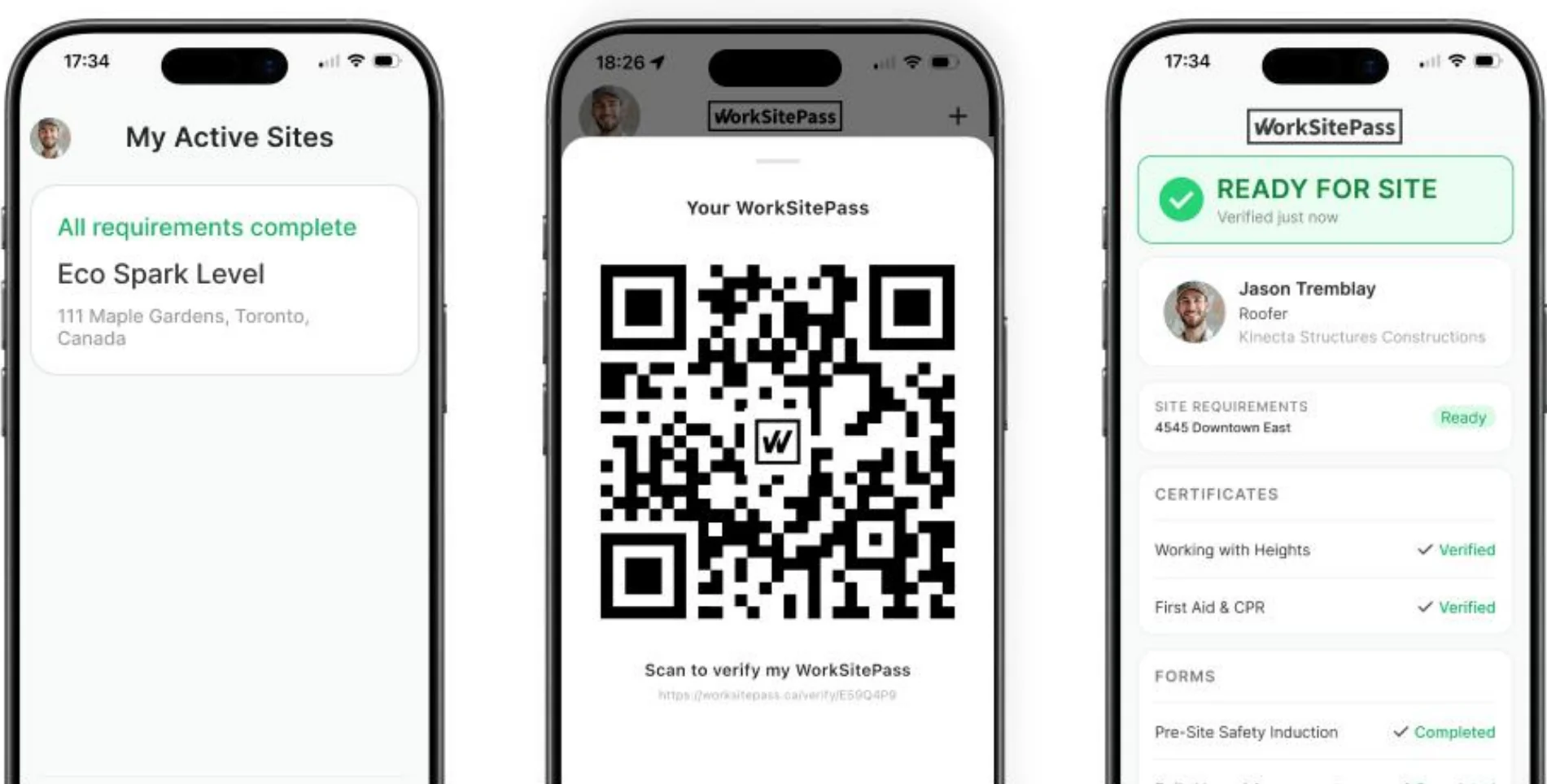
One wallet per worker satisfies every general contractor's requirements — which is the part subcontractors actually care about.
Impact — an honest account
What is validated
- The problem is real and consistently described — independently, in the same words
- Four roles need different things from one record — worker, sub, GC, supervisor
- The money case holds up: COR is bid eligibility in Ontario and a rebate in Alberta
- The gap is a user, not a feature — incumbents serve the desk
- Contractors will sign up and start a trial — the pitch gets a yes
What is not validated
- That a trial converts to paid — none have yet
- That supers adopt it without a mandate from the GC
- That verification scales beyond manual checking
What I'd measure next: trial-to-paid conversion and where trials stall, time to first cleared worker after signup, the share of gate checks done in-app vs. by phone call, and expiries caught before the gate vs. at the gate.
What surprised me, and what I'd do differently
I sent around a thousand cold emails and got essentially no replies. The same message, asked as a question in a real conversation, worked almost every time. The problem was never the audience — it was that I was pitching before I'd earned the right to.
01
Talk to ten people before designing anything
I designed a desk dashboard for a user who wasn't the one with the problem. Ten conversations first would have saved months of work.
02
Write the problem down and defend it
The one-sentence version — certs visible before anyone reaches the gate — should have existed on day one, not month six.
03
Instrument from the first release
A lesson carried over from my last enterprise product: time-to-first-cleared-worker should have been measurable the day the product went live.
My last two products taught me the same thing from opposite directions: find out whether you're right before you spend a year being confident.